Project 01 · Acquisition
Zero-Touch Customer Onboarding Redesign
Replacing phone-tag onboarding with self-serve intake, AI-personalized comms, and a status page customers can actually see.
Company
Enderby Gas is a family-owned propane distributor in North Texas — 85 years in operation, roughly $7M in annual revenue, about 20,000 active accounts, run by a lean team of fewer than 25. Core operations live in the Cargas ERP with IoT tank monitors in the field. Strong market position and a loyal base — but the customer-facing workflows were still almost entirely analog.
Situation — the "before" workflow
When someone needed propane service for the first time, the process looked like this:
- The prospect calls the dispatch line during business hours. If lines are busy, they wait on hold or leave a voicemail.
- A dispatcher handwrites or types the intake — name, address, tank size, property type, heat source, install window.
- The dispatcher re-keys all of it into Cargas.
- Site visits get scheduled over the phone, usually two or three rounds of phone tag.
- Quotes go out by email, or printed and mailed.
- Installation dates get booked manually, by phone, in another round of coordination.
- The customer waits two to four weeks with no proactive updates. To check status, they have to call back in.
There are four specific failure points in that workflow:
- Manual phone intake. Acquisition capacity is capped by how many calls dispatch can take — and 42% of customers actively avoid calling support if they can.
- No status visibility. Customers sit in an information black box for weeks, which generates anxiety and triggers a second wave of inbound calls.
- Scheduling chaos. Phone tag, paper records, and disconnected calendars create double-bookings and routing errors.
- Dropped pipeline. All of the above means prospects abandon — and 44% of service-subscription cancellations happen in the first 90 days, where every minute of added onboarding friction lowers conversion.
Task
Redesign the Acquire stage so prospects could self-serve intake, get instant confirmation, and see real-time status — and never need to call in unless something genuinely required a human. The constraint: nothing could disrupt Cargas, and the warm, relationship-driven service the company is known for had to come through in every automated touchpoint.
Action — a six-layer "zero-touch" architecture
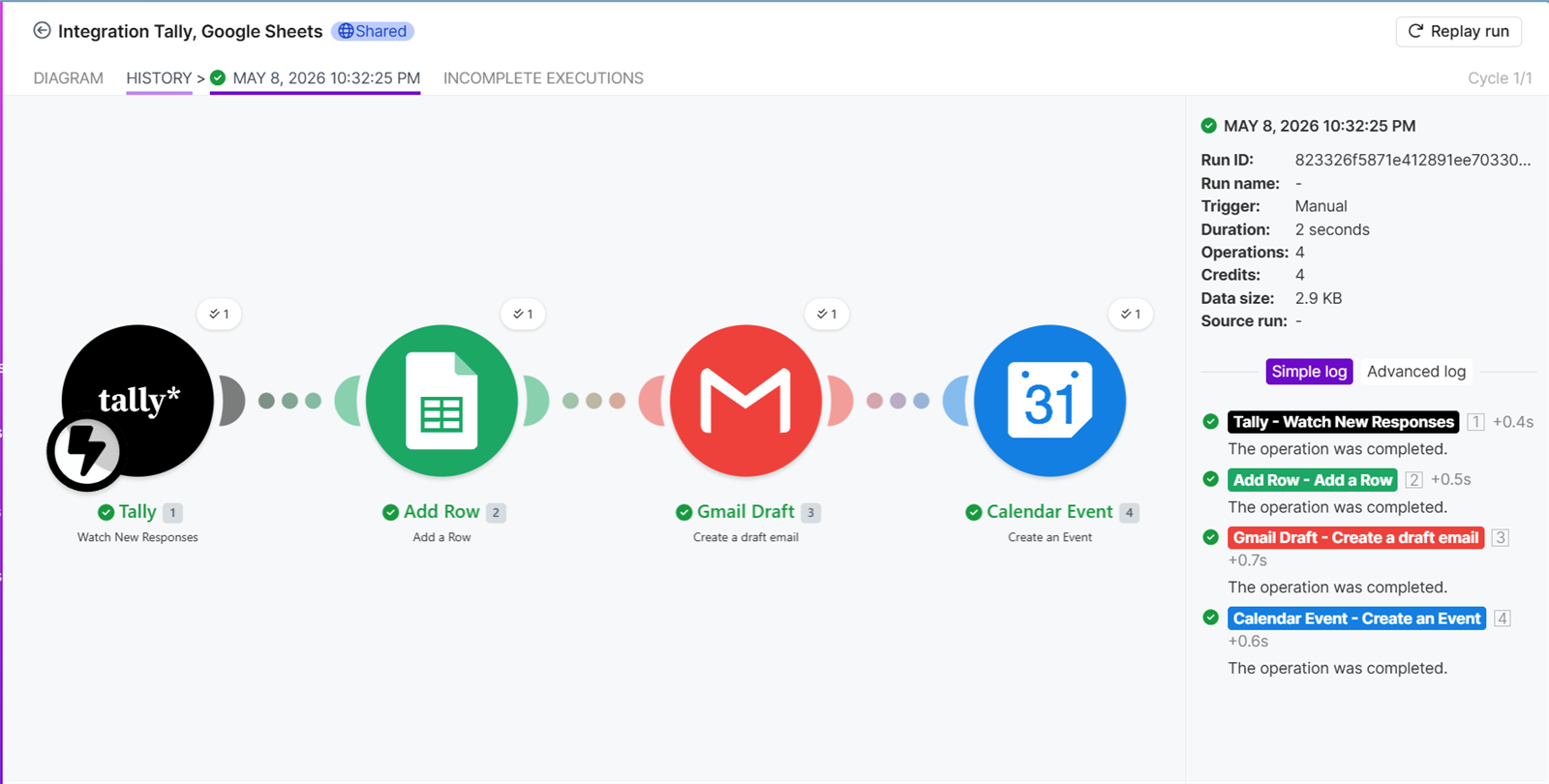
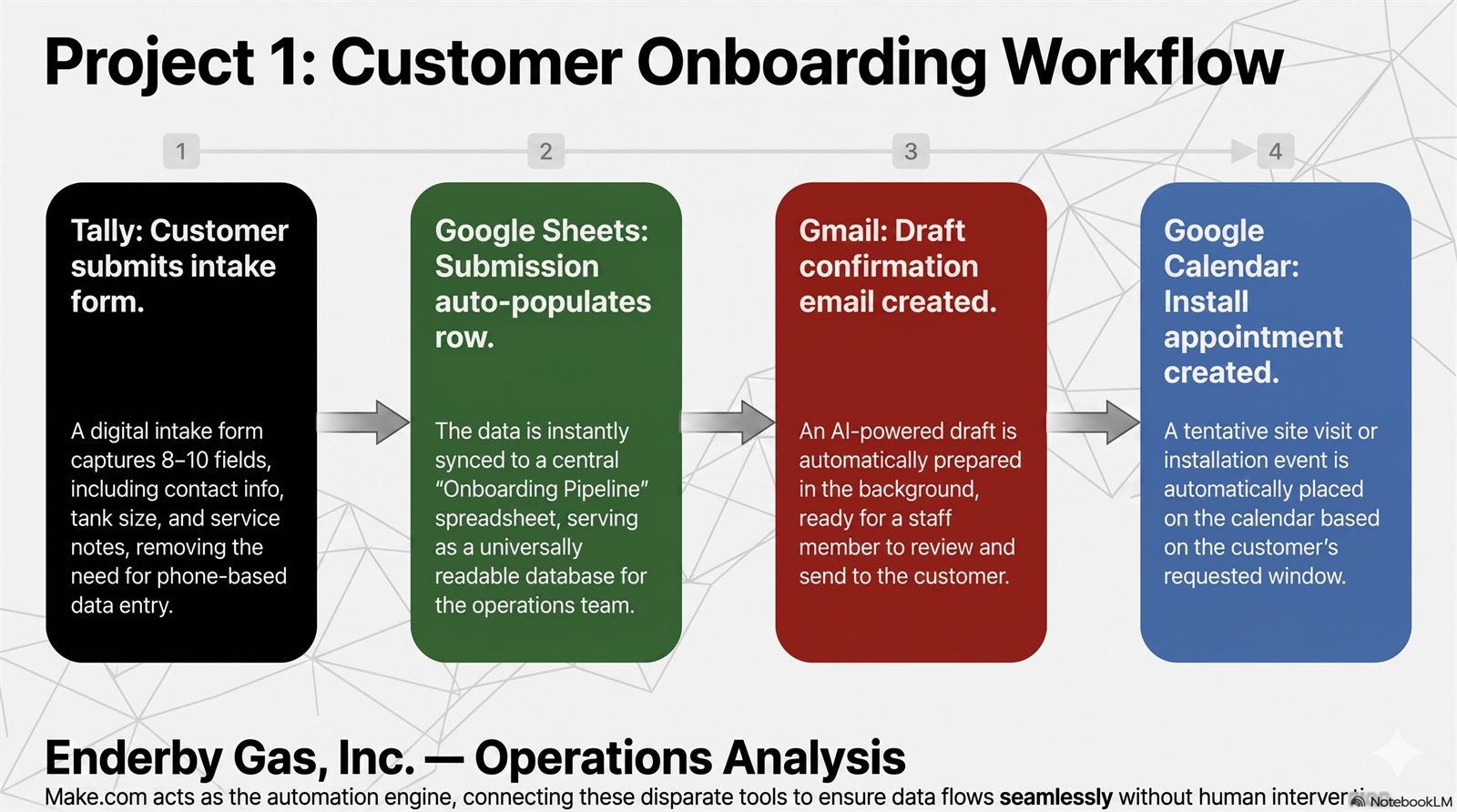
I built a six-layer architecture connecting tools the company already had in Google Workspace, plus Tally and Make for the front-end and orchestration work.
| Layer | Tool | Role |
|---|---|---|
| Intake | Tally | Embedded web form, no login required. Conditional logic branches commercial vs. residential — ten total fields, but no prospect sees all ten. |
| Database | Google Sheets | Three tabs — raw intake, cleaned records, dashboard aggregates. The separation lets cleanup logic change without breaking the dashboard. |
| Orchestration | Make | Two scenarios: one validates new submissions and fires Sheets, Gmail, Calendar, and the portal in parallel; the second watches the sheet for status changes and triggers customer updates. |
| Communication | Gmail + Gemini | Confirmation & status emails drafted by Gemini using the customer's own variables — property type, heat source, install window — so it never feels canned. |
| Scheduling | Google Calendar | Auto-creates internal events with the full customer payload in the description and assigns the right regional queue. No dispatcher coordinator needed for the first pass. |
| Status visibility | Google Sites | A per-customer status portal that updates as the install progresses — the call-deflection layer. |
Design decisions worth flagging
- The three-tab Sheet separated raw from cleaned data so I could iterate on cleanup logic without breaking anything downstream — reusable across any intake workflow.
- Tally's conditional logic is what made the form short enough to actually finish. Commercial prospects answer different questions than residential ones, and asking everyone everything is the fastest way to lose them.
- The Sites portal was the cheapest, highest-leverage piece. Customers don't call to ask "where am I" when they can see it on a page.
- Gemini for the email layer was the difference between "this feels automated" and "someone wrote me back." That mattered more than any other AI choice in the build.
Result — projected impact
To be clear about what these numbers are: this case study uses published industry benchmarks because no proprietary Enderby data appears anywhere in my portfolio. These are the expected results based on comparable workflow-automation deployments.
| Metric | Expected improvement | Source context |
|---|---|---|
| Onboarding cycle time | 67% faster | Workflow automation in client onboarding |
| Time-to-live | 21 → 8 days | AI-driven onboarding benchmark studies (62% reduction) |
| Data accuracy | +88% | Digital intake replacing manual transcription |
| Inbound status calls | 58% → 15% | Self-service portals in utility / financial sectors |
| Early-life churn | −25% | Automated onboarding workflows |
| Annual hours saved | 240–360 hrs | Routine task automation, per employee |
| Operational cost | −20–30% | Baseline workflow-automation initiatives |
In plain terms: a customer who used to wait three weeks now sees their first service date in about a week. The dispatcher who used to spend the morning on status calls now spends it on real coordination. And the prospects who used to ghost during the wait stay in the pipeline because they can see what's happening.
What I'd do next
The next step is a two-week controlled pilot with residential prospects only. The go/no-go criteria: a 90% reduction in manual transcription, zero data loss in the Make webhook routing, and documented dispatcher shadowing on every AI-drafted email before send. Once that holds, the expansion path covers commercial and agricultural accounts, where the intake form has to handle regulatory and hardware specifics.
Beyond that, this onboarding data becomes the seed corpus for the Knowledge Capture system (Project 2) and the operational logic layer for the AI receptionist pilot (Project 3). The point of building Project 1 this way was to make Projects 2 and 3 possible.
Businesses that benefit from this pattern
This architecture fits any business where a new inquiry moves through several people, customers call for status, or information gets retyped between a form, inbox, calendar, and spreadsheet. Strong candidates include home services, installation businesses, professional practices, recruiters, distributors, and other appointment- or project-based teams.
A practical first engagement
Map the current intake flow, choose one source of truth, build the capture and follow-up automation, add a status or reporting view, test with simulated records, and document the manual fallback. The full PDF shows the detailed architecture and reasoning.
Enderby Gas is a real company used with the owner's permission. All names, customer data, and operational figures are simulated for portfolio purposes; impact figures are projected from published industry benchmarks, not deployed results. No proprietary records were used.
Back to all projects