Project 02 · Retain (Internal)
Institutional Knowledge Capture
Giving 85 years of operational know-how a permanent home — searchable, cited, and answerable in plain language.
"85 years of operational knowledge lived in the heads of two people. This project gave it a permanent home."
Situation
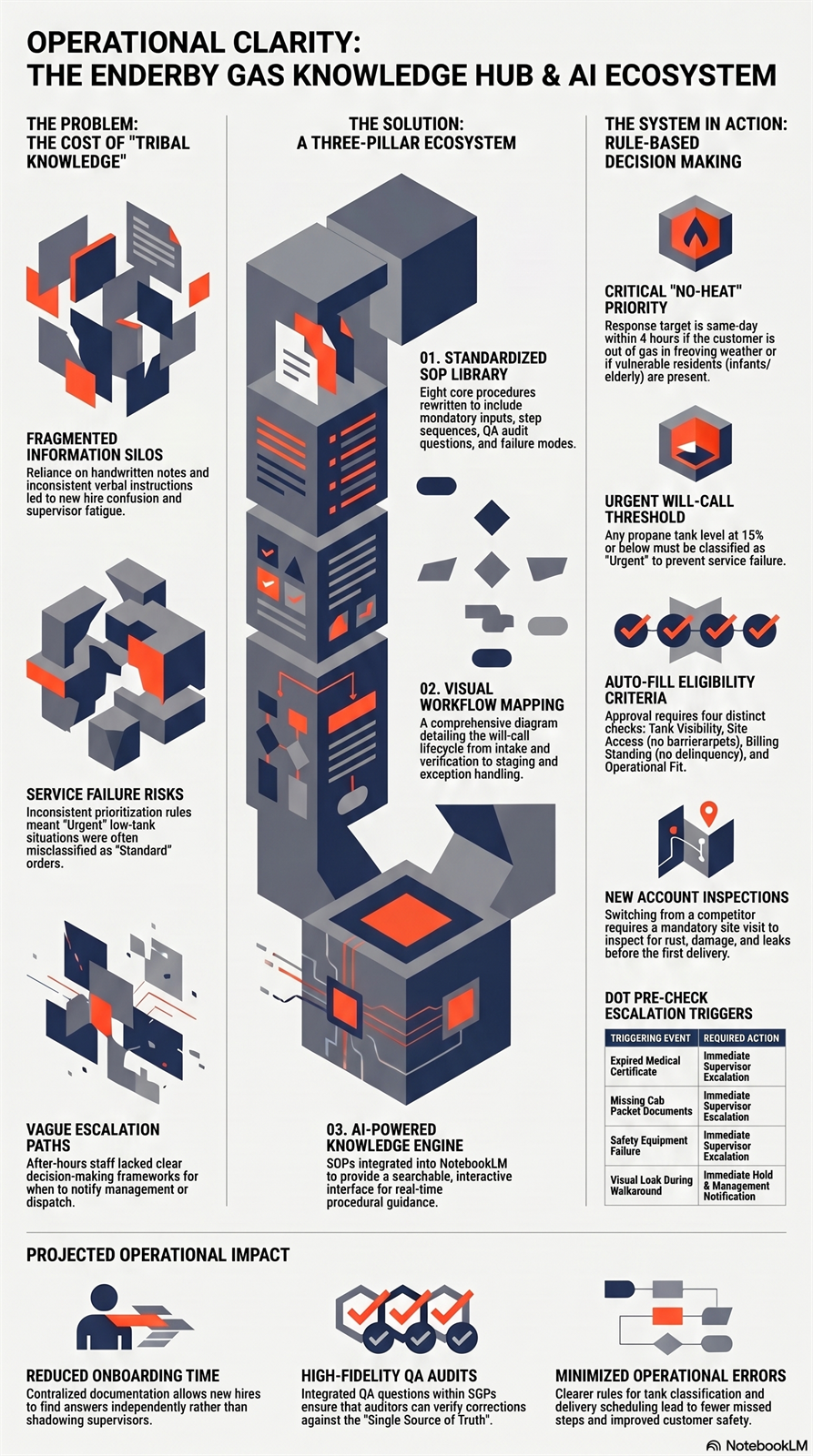
At Enderby Gas, the most critical operational knowledge had never lived in a document — it lived in people. Dale, the senior dispatcher, knew every customer quirk, every winter road condition, and exactly how to triage a no-heat emergency at 2am. That expertise is irreplaceable until someone retires, gets sick, or simply isn't available when a new hire needs an answer.
| Pain point | Business impact |
|---|---|
| No documented SOPs for core dispatch tasks | New hires take 6+ months to become independent; errors spike during onboarding |
| Emergency protocols exist only in Dale's memory | An untrained employee on a no-heat call risks delayed response and liability |
| No searchable internal knowledge base | Every question interrupts a senior employee — a bottleneck that compounds in peak season |
| No way to transfer knowledge when staff leave | One retirement creates immediate operational risk |
Task
Capture the most critical operational knowledge into a structured, searchable, AI-powered knowledge base — using only free-tier Google Workspace and Google AI tools, usable by employees of any technical comfort, and demonstrably useful from day one.
Action — what I built
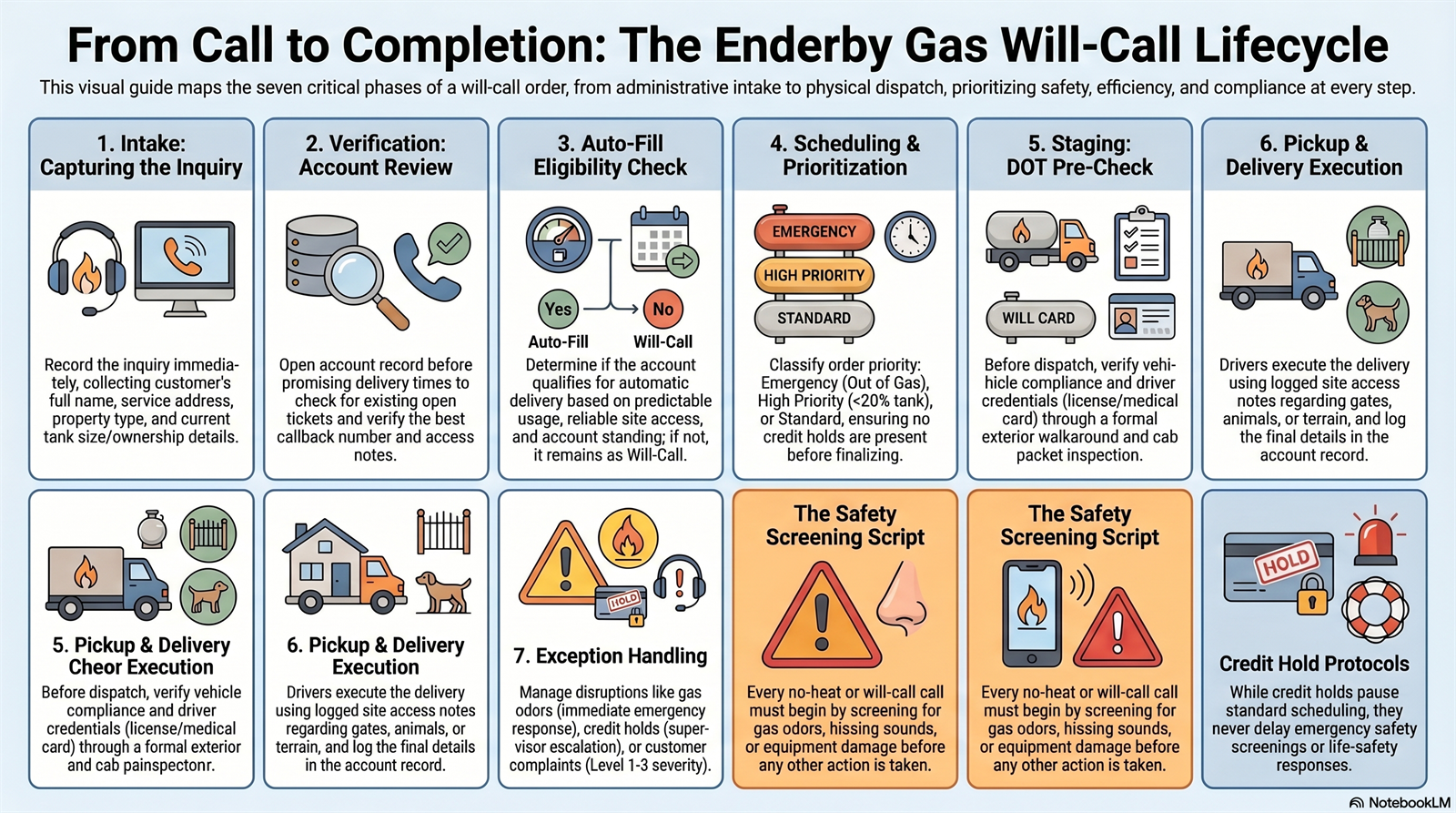
1. Five core SOPs (Google Docs)
Written in Dale's voice — a senior dispatcher speaking directly to a new hire — so they read like institutional knowledge being transferred, not policy docs. Each includes purpose, applicability, numbered steps, exception callouts, escalation rules, and common mistakes.
- Will-Call Order Procedure
- No-Heat Emergency Triage
- New Customer Onboarding
- DOT Inspection Pre-Check
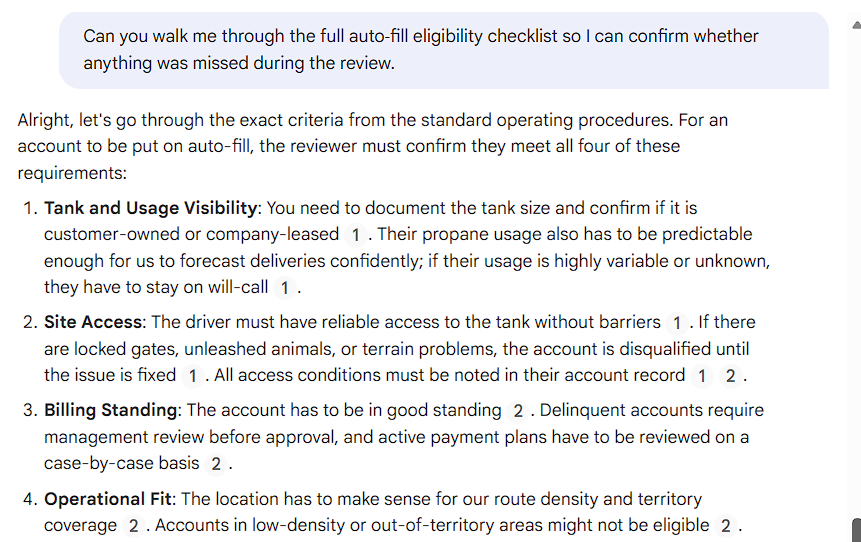
- Auto-Fill Eligibility Rules
2. NotebookLM knowledge base
All five SOPs uploaded into an "Enderby Operations Library" notebook, so employees can ask questions in plain language and get answers cited directly from the source documents — not generic AI guesses.
3. A custom Gemini Gem, "Dale"
A persona-driven assistant configured to answer only from the SOPs, flag out-of-scope questions instead of inventing answers, and lead with the most critical action first in emergencies (no-heat, gas smell).
NEW HIRE: "A woman just called, crying — no heat, freezing outside, husband on oxygen. What do I do?"
DALE: "Don't put her on hold. First, ask if she smells gas anywhere. If yes — tell her to leave the house, don't touch switches, call 911 from outside. If no gas smell, this is CRITICAL: elderly/medically vulnerable in freezing temps is same-day within 4 hours. Don't wait for approval…"
The response mirrors the exact priority framework documented in the No-Heat Triage SOP — proving the assistant retrieves and applies real procedure, not generic answers.
Result — projected impact
| Metric | Estimated impact | Source context |
|---|---|---|
| New-hire time-to-independence | 6+ mo → 6–8 wks | Structured onboarding & documented SOPs |
| Senior-employee interruptions | −40–60% | Searchable KB, first 90 days per new hire |
| Emergency-call accuracy | Improved | New hires follow documented protocol vs. improvising |
| Knowledge retention on departure | De-risked | Core procedures now documented & searchable |
| Build cost | $0 | Free-tier Google Workspace & Google AI |
"This system doesn't replace Dale. It means Dale's knowledge survives Dale."
Businesses that benefit from this pattern
This approach is valuable when long-tenured staff answer the same questions repeatedly, training depends on shadowing, procedures vary by person, or the owner worries that critical knowledge could leave with one employee. It is especially useful for field service, distribution, healthcare administration, professional services, and other process-heavy teams.
A practical first engagement
Identify the five highest-risk procedures, interview the people who know them, write consistent SOPs, build a cited NotebookLM source set, test realistic questions, and define where the assistant must escalate instead of answering.
Enderby Gas is a real company used with the owner's permission. All names, customer data, and operational figures are simulated for portfolio purposes; impact figures are projected from published industry benchmarks, not deployed results. No proprietary records were used.
Back to all projects